Every Body, Every Beat: How Taiko Teachers Are Dismantling the Barriers That Keep Practitioners Away
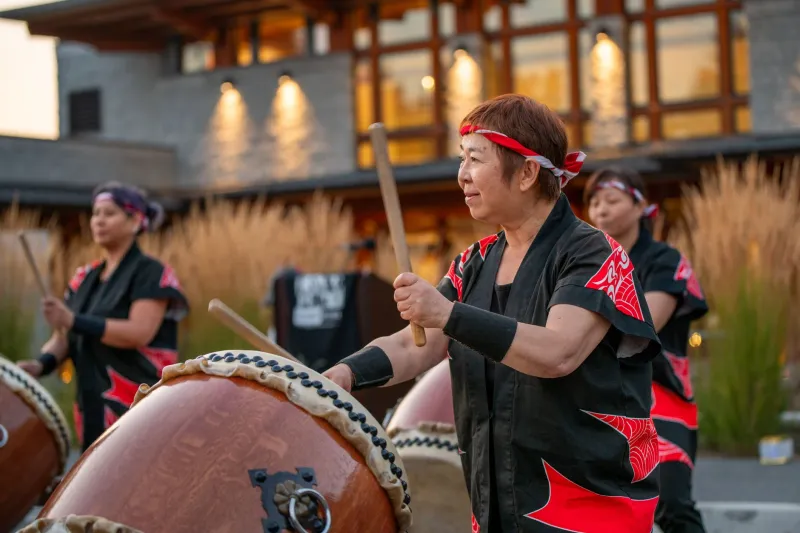
Stand before a nagado-daiko — the long-bodied barrel drum that anchors most taiko ensembles — and the physical assumptions embedded in the practice become immediately apparent. The drum is positioned at a specific height. The striking angle demands a particular shoulder range of motion. The foundational stance, with feet wide and knees bent, presupposes a degree of lower-body strength and mobility that not every prospective student possesses. For someone whose body does not match those parameters, the message can feel unambiguous, even if unintentional: this space was not designed for you.
A growing number of taiko instructors across the United States are working to change that message, one adaptation at a time.
The Invisible Threshold
The barriers to taiko participation are rarely discussed openly, which is part of what makes them so persistent. Financial cost is one of the most significant. Quality taiko drums are expensive — a single nagado-daiko can cost thousands of dollars — and many community groups operate with limited equipment, making it difficult to accommodate students who require modified drum heights or alternative positioning. Studio space is another constraint: taiko demands room, and many urban practitioners find themselves squeezed into spaces that barely accommodate standard practice configurations, let alone adaptive setups.
Physical requirements present a further layer of complexity. Conventional taiko technique involves sustained overhead striking, deep stances, and explosive full-body movement. For practitioners managing chronic pain, mobility impairments, differences in limb length or body size, or conditions affecting grip and coordination, the standard curriculum can feel not merely challenging but genuinely prohibitive.
"Nobody ever told me I couldn't do taiko," recalls one practitioner in her forties who began studying after a spinal injury. "But when I walked into my first class and watched the warm-up, I knew that what I was seeing wasn't going to work for my body. I almost left before we even touched a drum."
She did not leave. But she acknowledges that many others in similar situations do.
Rethinking the Drum's Physical Language
The instructors who are most actively addressing these barriers share a common starting point: the conviction that taiko's essence lies not in any particular physical form, but in the relationship between practitioner and drum — and that relationship can be cultivated in many different ways.
Practical adaptations range from the straightforward to the ingenious. Some teachers have begun using adjustable drum stands that allow the instrument to be raised or lowered to accommodate students of different heights or those who practice from a seated position. Others have experimented with smaller drum sizes that require less reach and generate less physical strain while still delivering the resonant feedback that makes taiko so compelling.
Strike technique itself is also being reexamined. The canonical overhead strike, dramatic and visually striking, is far from the only way to produce meaningful sound from a taiko drum. Side strikes, wrist-led strokes, and variations that minimize shoulder involvement can allow students with upper-body limitations to participate fully in ensemble playing without approximating a movement their bodies cannot safely perform.
"I had a student with limited range of motion in one shoulder," explains one instructor based in Chicago. "We spent three sessions just exploring what she could do — what angles felt safe, what sounds she could generate, what rhythms worked with her body rather than against it. By the end, she was playing in our ensemble. Her part sounded different from the standard part. It sounded like her."
The Seated Taiko Question
Perhaps the most visible expression of adaptive taiko practice is the growing interest in seated performance — configurations in which practitioners play from chairs or wheelchairs, with drums repositioned accordingly. While seated taiko has existed in various forms for decades, it has historically occupied a marginal position within American taiko pedagogy, treated as a modification of last resort rather than a legitimate practice mode in its own right.
That framing is beginning to shift. A small but dedicated cohort of teachers is developing seated taiko curricula that are not simply adaptations of standing technique, but genuinely distinct approaches that take full advantage of the stability and alternative movement possibilities that a seated position affords.
"When you're seated, you lose some things and you gain others," notes one practitioner and teacher in the Pacific Northwest who uses a wheelchair. "You lose the big leg drive. But you gain incredible upper-body freedom, and you can do things with your arms and wrists that standing players can't easily access. I'm not playing a diminished version of taiko. I'm playing my version of it."
His ensemble has performed at regional festivals and cultural events, and he reports that audience responses consistently focus not on what his playing lacks, but on what it expresses.
Financial and Spatial Inclusion
Beyond the physical dimension, instructors working toward greater inclusivity must also grapple with the economic and logistical realities that shape who can access taiko training in the first place.
Some schools have introduced sliding-scale tuition, equipment-lending programs, and scholarship funds specifically aimed at students from lower-income backgrounds. Others have partnered with community centers, disability organizations, and public libraries to bring taiko instruction into spaces that are already accessible and familiar to populations who might not seek out a dedicated dojo.
These efforts are not without their own challenges. Adaptive equipment costs money. Modified curricula require additional teacher training and preparation time. And the cultural and institutional knowledge needed to work effectively with students who have specific accessibility needs is not something most taiko instructors have received in their own training.
"We're figuring this out as we go," admits one ensemble director who has been working to make her program more inclusive for the past three years. "There's no established playbook. But the conversations we're having — about who this art form is for, about what we assume when we design a curriculum — those conversations are making us better teachers for everyone, not just for students who need adaptations."
The Drum Belongs to Everyone Who Answers
Taiko's history in America is, at its core, a story about communities claiming an art form and making it their own under circumstances that were often difficult and sometimes hostile. The Japanese-American practitioners who built the American taiko movement in the late twentieth century did not ask permission to adapt the tradition to their context. They brought it into their lives, their grief, their resilience, and their joy.
The teachers and practitioners who are now working to make taiko accessible to bodies that the tradition's conventional forms have overlooked are doing something continuous with that history. They are insisting that the drum's invitation is genuine — that it extends not only to those for whom the standard stance is comfortable, but to everyone who feels the pull of that sound and wants to know what it is like to make it themselves.