Strike and Stand: The Shared Soul of Taiko and the Martial Arts
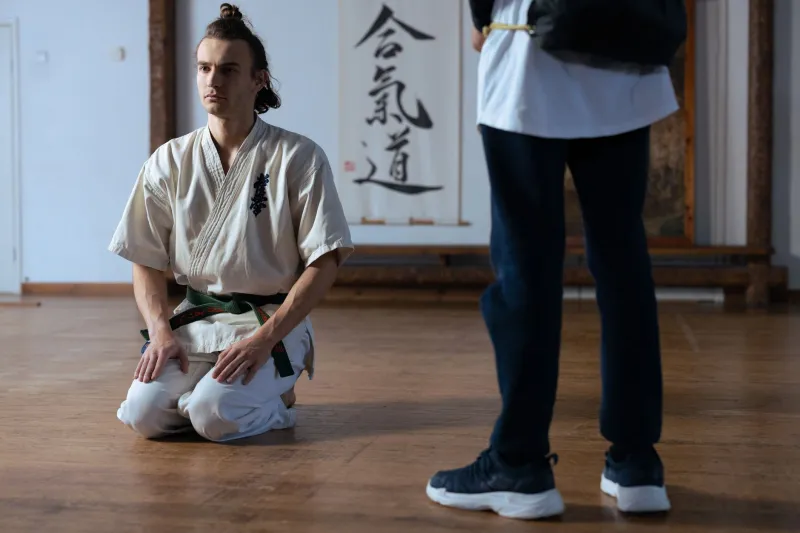
At first glance, a taiko ensemble and a karate dojo appear to inhabit entirely different worlds. One fills a concert hall with thunder; the other operates in disciplined silence broken only by the sharp exhale of a kiai. Yet spend an afternoon observing both, and a striking pattern emerges: the same vocabulary keeps surfacing. Hara. Centeredness. Breath. Intention before action. The body as instrument.
Across the United States, a growing number of practitioners are no longer treating these traditions as separate pursuits. They are cross-training deliberately — and what they are learning is reshaping how both communities think about physical discipline, cultural transmission, and the nature of presence itself.
The Body Speaks the Same Language
Sensei David Murakami, who teaches both Shotokan karate and participates in a community taiko ensemble in the San Francisco Bay Area, describes the realization as almost embarrassingly obvious once it arrived. "I was coaching a student on their tsuki — their thrust punch — and I kept telling them to initiate from the center, to let the hips drive the arms. Two weeks later, I was at taiko practice hearing my drum instructor say the exact same thing about a don strike. I almost laughed out loud."
The biomechanical parallels are real and well-documented among those who have studied both forms. In karate, power generation begins at the tanden, the energetic center located roughly two inches below the navel. In taiko, instructors consistently direct students to the same anatomical region when teaching how to draw force through the bachi — the drumstick — without relying on arm strength alone. Both disciplines treat the extremities as conduits rather than sources of power.
Aikido presents an even more direct philosophical overlap. Rooted in the idea of harmonizing with an opponent's energy rather than opposing it, aikido practitioners develop an acute sensitivity to timing and flow. Yoshiko Tanaka, an aikido instructor and taiko performer based in Seattle, Washington, argues that rhythm is not merely metaphorical in her dual practice. "In aikido, you are reading a rhythm — the rhythm of another person's movement, their breath, their intention. In taiko, you are reading the rhythm of the ensemble, the space, the audience. The listening is the same skill."
Breath as Foundation
Perhaps no single element bridges the two traditions more completely than breath control. In kendo — the Japanese sword art — practitioners are taught that a lapse in breath is a lapse in awareness, an opening that a skilled opponent will immediately exploit. The concept of zanshin, or sustained alertness, depends entirely on regulated, conscious breathing.
Taiko ensembles in America have long emphasized breath as both a musical and a communal tool. Groups often breathe together before a performance, using a shared inhalation to synchronize not just timing but emotional intent. What is less widely discussed is how this practice mirrors pre-combat breathing rituals in multiple Japanese martial arts, where a collective breath among training partners signals readiness and mutual respect.
James Okafor, a kendo practitioner and taiko student at a community center in Chicago, Illinois, began cross-training after noticing that his breath collapsed under performance pressure in both disciplines simultaneously. "When I got nervous in a kendo match, I held my breath. When I got nervous during a taiko performance, same thing — everything tightened. I started working with my kendo sensei on breathing exercises and brought them into my drum practice. The improvement in both was immediate."
American Dojos Open the Door
The convergence is beginning to manifest institutionally. Several martial arts schools across the country have started incorporating taiko elements — not as novelty programming, but as a serious pedagogical tool. A dojo in Portland, Oregon, recently introduced monthly taiko workshops for intermediate karate students, framing the sessions explicitly around the development of ma — the Japanese concept of meaningful interval or pause — which instructors felt students were struggling to internalize through kata alone.
"Kata can become mechanical," explained the dojo's head instructor in a recent community newsletter. "Taiko forces students to feel rhythm in their bodies, to understand that the space between strikes matters as much as the strikes themselves. That understanding transfers back to their forms in ways that verbal instruction alone rarely achieves."
Similarly, a martial arts and wellness center in Austin, Texas, has begun offering what it describes as an "integrated movement series" that pairs weekly taiko instruction with foundational aikido principles. Enrollment has exceeded projections in each of the two semesters since the program launched, drawing students who identify primarily with neither tradition but are drawn to the combined offering.
Spiritual Discipline and the Question of Presence
Beyond the physical, both taiko and the martial arts carry a dimension that American practitioners often describe with careful but genuine seriousness: the cultivation of presence. Not mindfulness in the contemporary wellness sense — though that connection exists — but something more demanding. The requirement to be entirely here, in this moment, with this instrument or this opponent, because anything less produces an audible or visible failure.
Maria Reyes, who studies both iaido — the art of drawing and cutting with a Japanese sword — and performs with a taiko group in Los Angeles, California, describes this shared demand as the reason she has continued both practices for over a decade. "In iaido, if your mind wanders, your draw is wrong. In taiko, if your mind wanders, the ensemble hears it. There is nowhere to hide in either practice. That is what keeps bringing me back. I am still learning how to be fully present."
This quality — accountability to the present moment — may be the deepest common inheritance of these traditions, and the most transferable across cultural and disciplinary boundaries.
A Dialogue Worth Deepening
The exchange between taiko and the martial arts in America is still in its early stages. It exists largely through individual practitioners who have found their way to both traditions and through a handful of forward-thinking schools willing to experiment with their curricula. Formal collaboration between taiko organizations and martial arts associations remains rare, though conversations are beginning to emerge at cultural festivals and Japanese-American community events where both communities share space.
What is already clear is that each tradition has something genuine to offer the other — not as dilution, but as illumination. The drummer who studies kendo learns something about the weight of stillness before action. The martial artist who takes up the bachi discovers that rhythm is not decoration but structure, not accompaniment but discipline.
The beat and the strike, it turns out, have always been asking the same question of the body: Are you ready? Are you here?
For practitioners in dojos and rehearsal spaces across America, the answer is increasingly being shaped by both.