Campus Beats: How University Taiko Clubs Became Unexpected Stewards of a Living Japanese Tradition
Photo: Unknown authorUnknown author, Public domain, via Wikimedia Commons
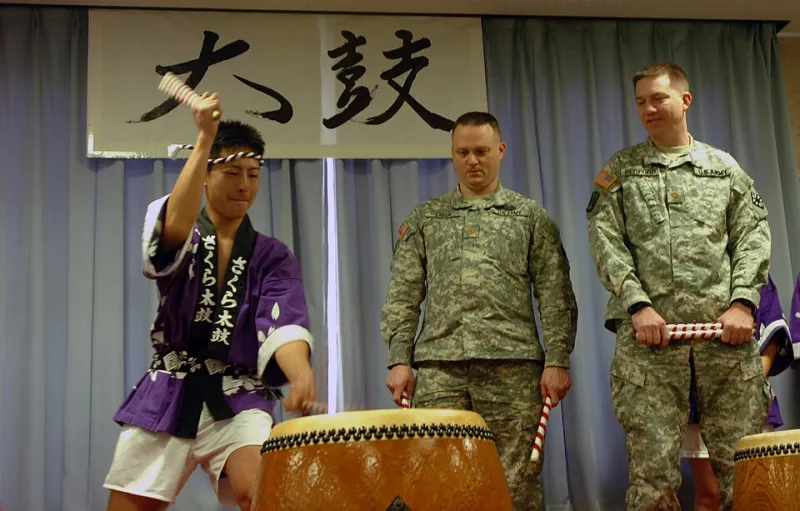
On a Thursday evening in a converted gymnasium at the University of California, Los Angeles, a group of eighteen students is doing something that would have seemed improbable just three decades ago. They are rehearsing a taiko composition of their own design—one that layers traditional Oedo Sukeroku rhythms against a polyrhythmic structure inspired by West African drumming. The students range from second-generation Japanese Americans to first-year students from Ohio who had never heard of taiko before arriving on campus. Together, they represent one of the most consequential—and least discussed—developments in American taiko history.
College taiko clubs have been proliferating at a remarkable rate. According to estimates from the Taiko Community Alliance, more than 150 university ensembles now operate across the United States, a figure that has roughly doubled over the past fifteen years. From the Pacific Northwest to the Mid-Atlantic corridor, campus groups have become primary entry points for an entirely new generation of practitioners—and, increasingly, innovators.
A Movement Rooted in Community, Sustained by Curiosity
The origins of collegiate taiko in America trace back to groups like San Jose Taiko, founded in 1973, and the pioneering work of community organizations in California that introduced the art form to younger audiences during the Asian American civil rights movement. Universities, particularly those with significant Japanese American student populations, became natural incubators.
What distinguishes the current moment, however, is the demographic breadth of today's campus ensembles. Club leaders at institutions including Northwestern University, the University of Texas at Austin, and Tufts University report memberships that are increasingly diverse, drawing students of non-Japanese heritage who are drawn to taiko for its physicality, its communal ethos, and its visual and sonic power.
"When I joined our club as a freshman, I expected it to feel like a history lesson," said one ensemble director at a large Midwestern research university. "What I found instead was something much more alive. We argue about arrangements. We debate what makes a performance authentic versus what makes it vital. Those are not small questions."
The Resource Problem—and the Creative Workarounds
Running a taiko ensemble as a student organization presents challenges that professional companies rarely face. A single nagado-daiko, the cylindrical drum most closely associated with ensemble taiko, can cost upward of two thousand dollars. A full set of instruments sufficient for a competitive performance might represent an investment of thirty thousand dollars or more—a figure that strains most student activity budgets to their breaking point.
The solutions students have devised reveal both their ingenuity and their commitment. Many clubs maintain relationships with local community taiko organizations, borrowing instruments in exchange for volunteer labor at festivals and events. Others have established fundraising pipelines through campus cultural nights, dining hall performances, and crowdfunding campaigns that have occasionally raised tens of thousands of dollars in a single cycle.
At least one ensemble—a group at a New England liberal arts college—has partnered with its university's music department to formally catalog and maintain instruments as part of the institution's broader percussion inventory, a model that other clubs have begun to replicate. "Sustainability is the word we come back to constantly," noted a club president who has spent two years negotiating exactly such an arrangement. "Every graduating class has to leave the organization stronger than they found it. That's the obligation."
From Rehearsal Space to Festival Stage
Perhaps the most visible measure of collegiate taiko's growing influence is its presence on the American festival circuit. Groups that began performing exclusively at campus multicultural fairs now regularly appear at major taiko festivals, Japanese cultural celebrations, and even mainstream music events. The Cherry Blossom festivals in Washington, D.C., and San Francisco have become important platforms, as have regional gatherings organized by taiko networks across California, Texas, and the Pacific Northwest.
This visibility carries real cultural weight. For many festival audiences—particularly those with no prior connection to Japanese tradition—a university taiko ensemble may represent their first meaningful encounter with the art form. Club members are acutely aware of this responsibility.
"We are not a museum exhibit," said one student artistic director whose ensemble has performed at five major festivals in the past two years. "We are not trying to freeze taiko in 1970. But we also take very seriously the idea that we are introducing people to something with deep roots. Getting that balance right is the hardest part of what we do."
Innovation at the Intersection
It is at the intersection of tradition and experimentation that collegiate taiko may be making its most lasting contribution. Unconstrained by the commercial pressures that professional ensembles face, and energized by the interdisciplinary environment of university life, student groups have become laboratories for hybrid forms that are gradually reshaping what American taiko can be.
Collaborations with university jazz ensembles, hip-hop collectives, and South Asian classical dance troupes have produced performances that challenge conventional boundaries. Some groups have incorporated spoken word and visual art projections into their sets. Others have worked with ethnomusicology faculty to develop original compositions rooted in rigorous historical research.
These experiments are not universally embraced within the broader taiko community. Some senior practitioners express concern that innovation undertaken without sufficient grounding in classical forms risks producing work that is superficially exciting but culturally shallow. It is a tension that the students themselves acknowledge and, in many cases, actively navigate through mentorship relationships with established sensei figures.
The Relay of Knowledge
What ultimately sustains collegiate taiko across the inevitable turnover of student membership—four years is the maximum tenure for any individual practitioner—is a culture of intentional transmission. Senior members train juniors with a seriousness that mirrors the apprenticeship structures of traditional Japanese arts. Club histories are documented. Foundational techniques are codified and passed down.
In this sense, the university taiko club has become something genuinely unusual in American cultural life: a student-run institution with a multi-decade memory and a clear sense of its own place in a living tradition. The drum that was struck in a dorm common room in 1995 echoes, in a very real way, in the performance that takes the festival stage today.
That continuity—fragile, hard-won, and entirely dependent on the voluntary commitment of young people who could easily spend their Thursday evenings otherwise—may be the most remarkable achievement of the collegiate taiko movement. And it shows no sign of slowing down.