Roots and Rhythms: How Grassroots Taiko Ensembles Are Forging a Distinctly American Percussion Identity
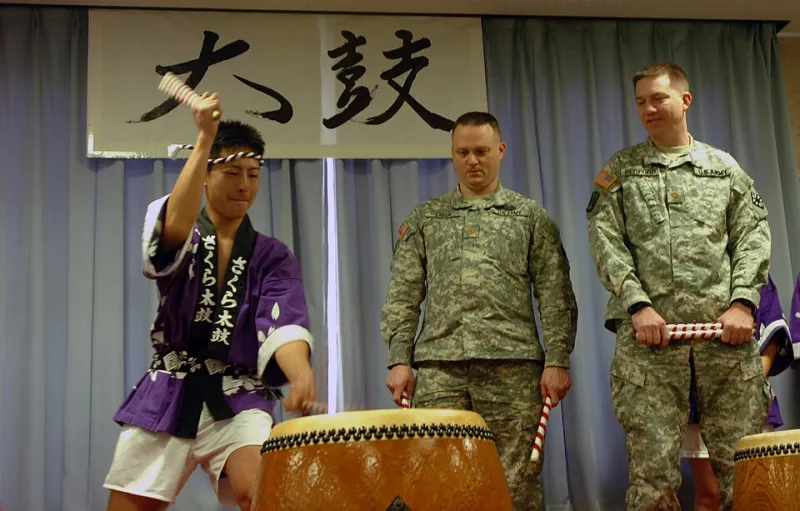
Photo: Department of Defense. American Forces Information Service. Defense Visual Information Center. 1994, Public domain, via Wikimedia Commons
On a Saturday afternoon in a converted warehouse space in Oakland, California, a dozen people ranging in age from their early twenties to their late sixties are rehearsing a piece that blends a traditional matsuri rhythm with a syncopated groove unmistakably influenced by American jazz. The ensemble, which formed less than four years ago, has already performed at two major West Coast festivals and drawn audiences who had never encountered taiko before walking through the venue doors. Their story is not exceptional. It is, increasingly, the norm.
Across the United States, taiko drumming has quietly evolved from a niche cultural practice maintained primarily within Japanese American communities into a thriving, decentralized performance movement. The ensembles driving this expansion are not, for the most part, large institutions with substantial funding. They are grassroots groups — passionate, resourceful, and deeply committed to honoring the art form while adapting it to the communities they serve.
From Living Rooms to Festival Stages
The trajectory of a typical American taiko group often begins modestly. A community center hosts a beginner workshop. A university student organization secures a practice space and purchases a single drum. A Japanese American cultural association decides to revive a tradition that had lapsed for a generation. These humble origins rarely predict the ambitions that follow.
San Jose Taiko, one of the oldest and most respected ensembles in the country, traces its founding to 1973 and the Japanese American community center movement that flourished in the Bay Area during that era. Its longevity has made it something of a model for newer groups, demonstrating that taiko can sustain itself as a performing art across decades without compromising its integrity. Younger ensembles frequently cite organizations like San Jose Taiko as proof that a grassroots beginning need not impose a ceiling on artistic achievement.
In cities without deep Japanese American roots, the story unfolds differently but with equal energy. Groups in Minneapolis, Atlanta, and Denver have emerged from university programs, multicultural arts initiatives, and, in several cases, the personal determination of a single individual who attended a workshop and refused to stop drumming. The internet has been an indispensable resource, allowing isolated practitioners to access instructional content, connect with established teachers, and find community where geography once made that impossible.
The University Pipeline
College campuses have become one of the most significant incubators for new taiko talent in America. Student taiko clubs now exist at dozens of universities, including UCLA, UC Berkeley, Stanford, the University of Michigan, and the University of Texas at Austin. These groups serve a dual purpose: they introduce the art form to young people who might otherwise never encounter it, and they generate a steady stream of trained performers who carry their skills into the broader community after graduation.
The university setting also encourages experimentation. Student ensembles frequently incorporate influences from hip-hop, West African drumming, and contemporary classical music into their arrangements, producing a creative cross-pollination that has gradually expanded the sonic vocabulary of American taiko. Faculty advisors and visiting master artists help ensure that this innovation remains tethered to a foundation of technical discipline and cultural respect.
"There is a real conversation happening on campuses about what it means to practice an art form that originates outside your own heritage," notes one instructor who has taught taiko at the collegiate level for over a decade. "Students are asking serious questions about cultural stewardship, and those questions are making the community stronger."
Regional Festivals as Community Anchors
If university programs serve as training grounds, regional festivals function as the public face of American taiko culture. Events such as the North American Taiko Conference, held biennially and drawing performers from across the continent, provide essential opportunities for groups to share techniques, collaborate across stylistic lines, and measure their artistic development against a broad field of peers.
Smaller, locally organized festivals have also proliferated in recent years. Portland, Seattle, Los Angeles, Chicago, and New York each host annual or semi-annual events that bring multiple ensembles together for a single program. These gatherings do more than showcase individual groups; they construct a sense of collective identity, reminding performers and audiences alike that American taiko is not a scattered collection of isolated practices but a genuine artistic community.
Festival programming has grown increasingly sophisticated, moving beyond simple showcase formats to include workshops, panel discussions, and collaborative performances that pair ensembles from different regions and backgrounds. This curatorial ambition signals a maturing field, one that is beginning to reflect seriously on its own history and direction.
Building a Distinctly American Aesthetic
Perhaps the most consequential development in the grassroots taiko scene is the gradual emergence of what practitioners and scholars are beginning to call an American taiko aesthetic — a performance sensibility that is neither a direct transplant of Japanese tradition nor a wholesale reinvention, but something genuinely hybrid.
This aesthetic is visible in the repertoire choices groups make, the physical staging they employ, the costuming they adopt, and the stories they choose to tell through rhythm. Many American ensembles have developed original compositions that address the Japanese American experience specifically — the internment of World War II, the struggles of immigration, the complexities of bicultural identity. Others have built bridges to African American, Latino, and Indigenous musical traditions, finding in taiko a percussive language capable of holding multiple cultural inheritances simultaneously.
The question of authenticity hovers over these developments, as it does over any living tradition that crosses cultural boundaries. Within the taiko community, that question is taken seriously and debated openly. Most practitioners appear to agree that respect for Japanese origins is non-negotiable, while also recognizing that a tradition transplanted to new soil must, to survive and flourish, put down new roots.
What Comes Next
The grassroots taiko scene in America shows no signs of contraction. New groups continue to form. Established ensembles are deepening their artistic programs and expanding their community outreach. Festivals are attracting larger audiences. And a new generation of performers, many of whom grew up watching taiko on streaming platforms and social media, is arriving at rehearsal spaces with both enthusiasm and informed expectations.
The challenge ahead is not one of growth but of stewardship — ensuring that expansion does not dilute the discipline and cultural thoughtfulness that have made American taiko a genuinely meaningful art form. The ensembles leading this movement appear acutely aware of that responsibility. In warehouses and community centers and university studios from coast to coast, the drums continue to speak.