Carried Forward: How the Children of Taiko Drummers Are Writing Their Own Relationship With the Drum
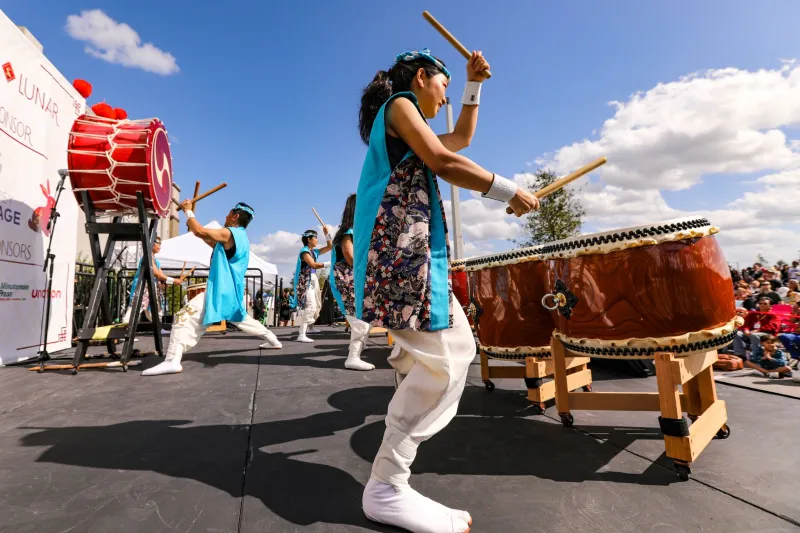
There is a particular kind of pressure that arrives not in the form of a command, but in the form of a memory. For many American-born children of taiko drummers, that memory is tactile: the vibration of a nagado-daiko felt through the floorboards of a community center, the smell of lacquered wood and sweat, the sound of their parent's voice calling out a rhythm they were expected to learn before they could fully understand why. These are the children of taiko's first American generation — and they are now adults, making choices about what to carry forward and what to set down.
Across the United States, a quiet but consequential shift is underway. The practitioners who built taiko into a recognizable cultural institution in America — through community groups, university ensembles, and touring performance companies — have raised children who grew up inside the tradition. Some of those children have stepped willingly into the circle. Others have stepped away. And a growing number are doing something more complicated: they are staying, but on their own terms.
The Weight of the Given Thing
For Maya Okamoto, who grew up in the San Francisco Bay Area watching her mother rehearse with a prominent community ensemble, the drum was never neutral. "It was always there," she says. "At family gatherings, at community events, at Japanese American cultural festivals. It wasn't something I discovered — it was something I was born into."
That sense of inheritance, she explains, created its own form of ambivalence. "I loved it and I also resented it a little. Because when you grow up inside something, you never get the experience of choosing it for the first time. You have to find your own way to choose it again, as an adult, on your own terms."
This experience — of needing to re-elect a tradition one was born into — is something that researchers and cultural educators who work with Japanese American communities have begun to examine more carefully. The question is not simply whether second-generation players continue the practice, but how the act of continuation changes when it is consciously chosen rather than passively absorbed.
Honoring Without Replicating
For some young drummers, the path forward has meant deepening their engagement with the tradition's Japanese roots in ways their American-raised parents sometimes did not. Kenji Watanabe, a 26-year-old drummer from Los Angeles whose father performed with a taiko group for two decades, spent a year in Japan studying with traditional practitioners after college. What he brought back surprised even him.
"My father's relationship with taiko was very much about Japanese American identity — about reclaiming something after the internment, about community, about visibility," he says. "That's profound and I honor it completely. But when I went to Japan, I started understanding taiko as something that also existed completely apart from that history. It had its own aesthetic logic, its own spiritual dimension. I came back wanting to hold both things at once."
This dual inheritance — the Japanese American political and communal history of taiko alongside its older, deeper Japanese cultural roots — is one of the defining tensions for second-generation players. They are, in a sense, heirs to two traditions simultaneously, and the work of synthesis is not always straightforward.
Permission to Walk Away
Not every child of a taiko drummer continues to play, and the community is beginning to reckon honestly with what that means. For some families, a child's decision to step away from the drum has been a source of quiet grief. For others, it has been accepted as a natural divergence.
Amanda Fujimoto, whose parents were both active taiko performers in Seattle throughout her childhood, stopped playing in her early twenties and has not returned. "I think people assume I rejected my heritage," she says. "But that's not it. I carry what taiko gave me — the discipline, the physical awareness, the sense of community — in everything I do. I just don't carry it through drumming anymore."
Her perspective points to something important: the values transmitted through taiko practice — perseverance, collective attentiveness, embodied presence — do not require continued performance to persist. The tradition, in this reading, is not located in the instrument alone but in the habits of character it cultivates.
Reimagining the Form
Perhaps the most visible expression of second-generation ownership is the willingness of young players to experiment with taiko's aesthetic vocabulary in ways that would have been unthinkable in earlier decades. Fusion projects pairing taiko with hip-hop percussion, electronic production, and contemporary dance have become increasingly common, and many of their practitioners are the children of more traditionally oriented performers.
"My parents' generation fought to be taken seriously," says Yuki Tanaka, a drummer and composer based in Chicago who blends taiko with jazz influences. "They had to be rigorous, almost conservative, because they were establishing legitimacy. My generation has the luxury of playing with the form because they did that work. I see what I do as a continuation, not a departure."
This generational relay — one generation securing the foundation so the next can build differently upon it — is a pattern familiar from other living traditions, and taiko in America appears to be entering precisely that phase. The question of what counts as authentic practice is being renegotiated in real time, and the negotiators are the children themselves.
The Conversation Continues
What is perhaps most striking about this generation is not the diversity of their choices but the seriousness with which they are making them. Whether they are deepening their study of Japanese sources, walking away with gratitude, or reimagining the form entirely, these young drummers share a common quality: they are thinking carefully about what they have been given and what it means to be its next custodian.
For taiko in America, this is not a crisis of continuity. It is a sign of a tradition mature enough to hold complexity — to be loved in more than one way, carried in more than one form, and passed forward by people who understand, perhaps better than any generation before them, that the most honest act of inheritance is not imitation but genuine engagement.
The drum endures. What changes is the relationship each new hand brings to it.