First Strike, First Step: How the Taiko Drum Is Opening Doors to Japanese Culture for a New Generation of Americans
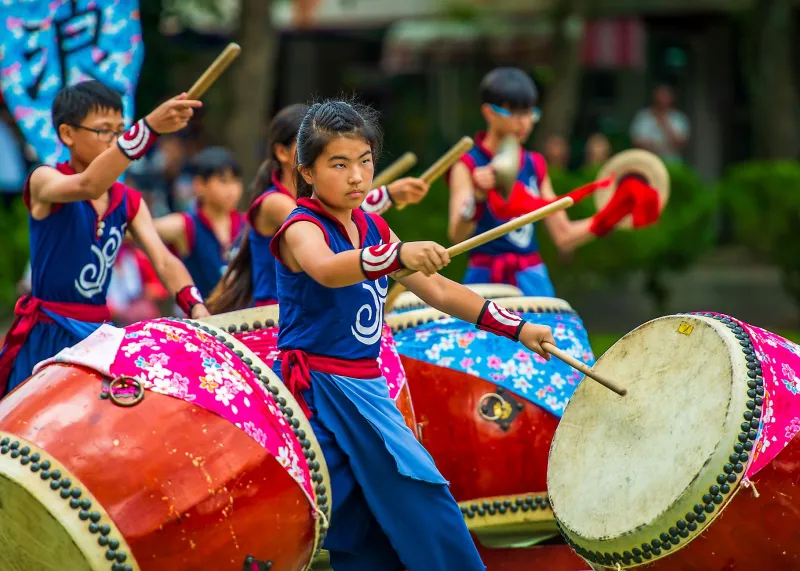
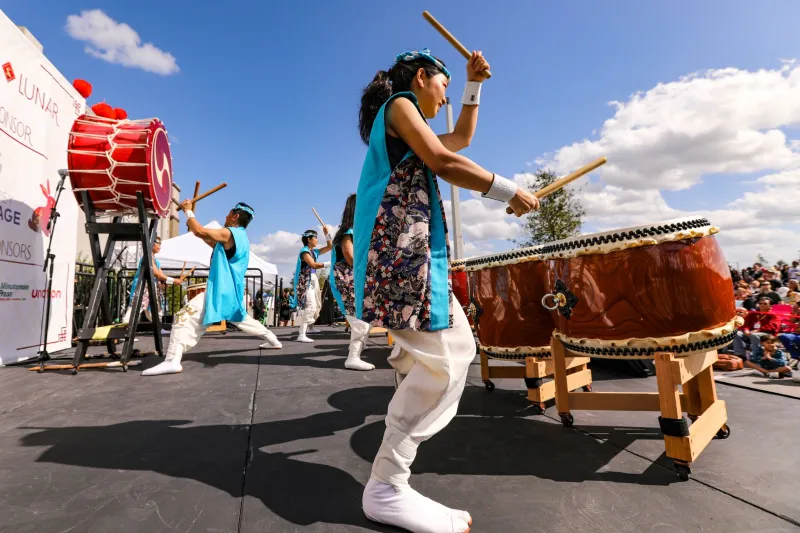
There is a moment that many taiko students describe with striking consistency. It arrives not during a performance, not after years of practice, but in the earliest sessions—when the resonance of a properly struck nagado-daiko travels up through the arms, settles somewhere near the chest, and refuses to leave. For some, that sensation is simply exhilarating. For others, it becomes a question: Where does this come from, and what does it mean?
That question, modest as it sounds, has quietly set hundreds of Americans on a path toward serious cultural study. Japanese language classes. Trips to regional festivals in Kyushu and Tohoku. Correspondence with taiko masters in Sado Island. Friendships forged across the Pacific. All of it beginning with a single, unhesitating strike.
The Drum as an Unlikely Cultural Curriculum
It would be easy to dismiss the phenomenon as a form of cultural tourism—enthusiastic but ultimately shallow engagement with a tradition that belongs to someone else. Critics have raised that concern, and it is not without merit. Yet the experiences of many practitioners suggest a more complicated and, in many respects, more admirable story.
Marcus Webb, a high school history teacher from Columbus, Ohio, joined a community taiko ensemble in 2018 with no particular interest in Japanese culture beyond a general appreciation for world music. Within eighteen months, he had enrolled in a beginner Japanese language course at a local university, purchased a subscription to a Japanese newspaper app, and spent two weeks in Niigata Prefecture attending a regional taiko festival.
"The drum kept asking me questions I couldn't answer," Webb explains. "Why does the player face away from the audience in certain pieces? What does the kata mean? What is the relationship between the music and the shrine? I couldn't just play and ignore all of that. It felt dishonest."
His trajectory is far from unusual. Across the United States, taiko instructors report that students with no Japanese heritage frequently develop some of the most rigorous commitments to contextual learning—driven, perhaps, by an awareness that they are engaging with something that does not belong to them by birthright and therefore demands a different kind of accountability.
What Instructors Are Observing
Naomi Tanaka, artistic director of a taiko organization in the San Francisco Bay Area, has taught students from dozens of ethnic backgrounds over two decades. She has watched the pattern emerge repeatedly: a non-Japanese student arrives curious, stays committed, and eventually begins asking questions that go well beyond technique.
"Some of my most dedicated cultural learners are people who grew up with no connection to Japan at all," Tanaka says. "They feel the weight of what they are doing. They understand, at some level, that they are borrowing something precious, and that sense of responsibility pushes them to learn."
She is careful to note that this does not happen automatically, nor is it universal. Responsible pedagogy matters enormously. When instructors situate taiko within its historical and social context—explaining, for instance, the instrument's role in Buddhist ceremonies, agricultural festivals, and wartime communication—students are far more likely to pursue that knowledge independently. When taiko is taught purely as a fitness activity or a performance spectacle, the cultural thread is easily lost.
This distinction has led a number of American taiko organizations to revise their introductory curricula, weaving cultural history directly into beginner sessions rather than reserving it for advanced study.
The Question of Belonging
Perhaps no aspect of this conversation is more delicate than the question of who has the right to practice, teach, and ultimately steward a tradition rooted in Japanese cultural life. It is a question the taiko community in America has wrestled with openly, and one that does not yield simple answers.
Japanese-American taiko organizations, many of which were founded during the civil rights era as explicit expressions of ethnic identity and political resistance, have historically maintained a strong sense of cultural ownership over the art form. That history deserves respect and recognition. At the same time, taiko has always been a living tradition—one that has evolved across centuries, traveled across oceans, and adapted to new communities without losing its essential character.
Many practitioners, both Japanese-American and otherwise, argue that the most meaningful form of participation is one grounded in genuine humility and reciprocity. Learning the language. Supporting Japanese and Japanese-American cultural institutions. Crediting lineages accurately. Returning to Japan, when possible, to study with masters whose families have carried these traditions for generations.
Amanda Reyes, a Mexican-American dancer from Los Angeles who began studying taiko in 2020, describes her approach as one of "constant listening." She attends Japanese cultural events in her community, volunteers with a local Japanese-American heritage organization, and has begun studying the history of Japanese immigration to California.
"I never want to be someone who just takes," she says. "Taiko gave me something extraordinary. I want to give back to the tradition and to the communities it comes from."
Language as the Deepest Gateway
Of all the secondary pursuits that taiko tends to inspire, language study may be the most revealing. Japanese is not an easy language for native English speakers, and the decision to undertake it seriously signals something beyond casual interest.
Enrollment data from several community Japanese language programs in cities with active taiko scenes—Seattle, Denver, Chicago, and Honolulu among them—suggests a modest but consistent uptick in adult learners who cite taiko as their initial motivation. Instructors at these programs describe a particular type of student: highly motivated, often older than the average beginner, and unusually focused on reading historical and ceremonial texts rather than conversational fluency alone.
"They want to understand the words in the songs," says one language instructor in Seattle who asked not to be named. "They want to read the inscriptions on the drums. That is a very specific and serious kind of motivation."
A Bridge, Not a Destination
What the taiko-to-culture pipeline ultimately reveals is something quietly significant about the nature of artistic practice itself. When an art form is taught with integrity—when its history, its social meaning, and its human context are held alongside its technical demands—it does not remain contained. It expands outward, pulling the curious practitioner into wider and wider circles of understanding.
For Americans who arrive at taiko without a pre-existing connection to Japanese culture, the drum becomes something more than an instrument. It becomes a threshold. What lies on the other side—language, history, community, and the long, intricate story of a civilization—is available to anyone willing to cross it with care.
The beat, in this sense, is only the beginning.