Scrolling Toward the Drum: How Gen Z Is Arriving at Taiko Through Digital Culture — and What Happens Next
It often begins with a video. A drummer in white striking an enormous barrel drum, the sound arriving half a second after the image. Or a scene from an anime series in which a festival performance crescendos into something that feels simultaneously ancient and electrifying. For a significant and growing number of Gen Z Americans, the first encounter with taiko does not happen in a cultural center or at a community festival — it happens on a phone screen, at two in the morning, somewhere between a cooking tutorial and a skateboarding clip.
What follows that encounter is where the story gets interesting.
The Algorithm as Cultural Gateway
Japanese popular culture has long served as an entry point for American youth into broader Japanese traditions. Anime, manga, and video game aesthetics have introduced generations of young people to Japanese mythology, aesthetic sensibilities, and historical contexts that they might not have encountered otherwise. What has changed in the past several years is the speed and reach of that introduction, and the degree to which taiko specifically has become part of the visual vocabulary of Japanese cool.
On TikTok and Instagram Reels, taiko performances accumulate millions of views. Clips from groups such as Kodo — the legendary Japanese ensemble based on Sado Island — circulate alongside short-form content from American university taiko clubs and informal backyard sessions. The algorithm does not distinguish between professional performance and student practice, between ceremonial context and entertainment spectacle. It surfaces what generates engagement, and taiko, it turns out, generates an enormous amount of it.
"I found taiko through a Demon Slayer edit," admits one nineteen-year-old who is now a member of a collegiate taiko group in the Southwest. "The music in that show uses a lot of traditional Japanese percussion, and I went down a rabbit hole. Six months later I was in a dojo."
Her trajectory is not unusual. Taiko instructors across the country report a measurable uptick in inquiries from students in their teens and early twenties, many of whom cite anime, Japanese gaming culture, or social media content as their initial point of contact.
From Aesthetic to Embodied Practice
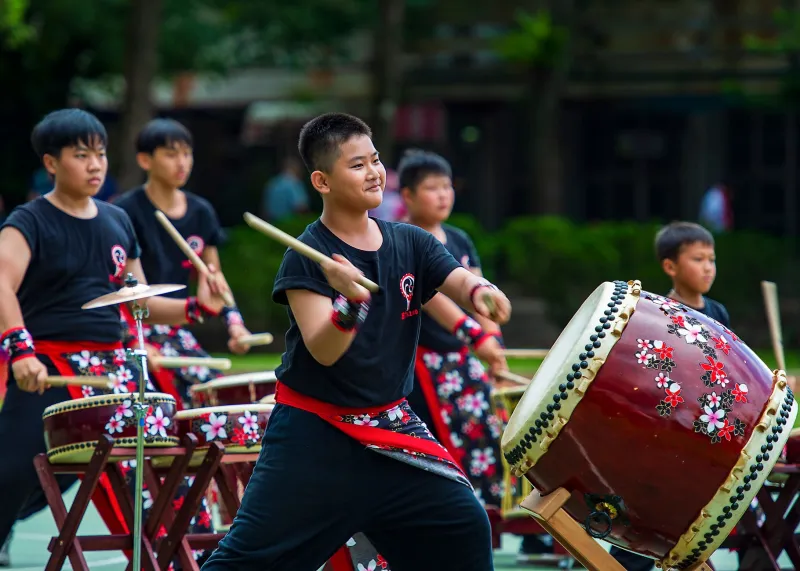
The distance between watching taiko and doing taiko is, however, considerable. The drum is physically demanding in ways that screens cannot convey — the weight of the bachi, the bruising that beginners accumulate across their forearms, the sheer cardiovascular intensity of a sustained performance. Students who arrive expecting a visually dramatic experience often find themselves confronting something far more demanding and, ultimately, far more rewarding.
"The kids who come in because of TikTok sometimes have a bit of a shock," observes one instructor at a community taiko school in Los Angeles. "They've watched a three-minute highlight reel. They haven't seen the two hours of kiai practice that came before it. But here's the thing — most of them stay. Because once they feel the drum under their hands, something shifts."
This transition from spectator to participant is, in many ways, precisely what taiko's advocates have always hoped for. The concern, however, is more nuanced than simple enthusiasm.
Navigating Gatekeeping and Cultural Respect
As taiko's digital visibility has grown, so too has the tension between accessibility and cultural integrity. For many Japanese-American practitioners and teachers — particularly those whose communities used taiko as a vehicle for reclaiming identity after the trauma of wartime incarceration — the art form carries a weight that a viral video cannot transmit.
This creates a genuine dilemma. Taiko teachers who are eager to welcome new students must also navigate the difference between enthusiasm and understanding, between appreciation and appropriation. The question of who gets to play taiko, under what conditions, and with what level of cultural awareness is one that communities across the country are actively wrestling with.
"I don't want to gatekeep," says one Japanese-American ensemble director in the Bay Area. "This art form has always evolved through contact with new communities. But I do want students to understand what they're entering. There's a history here. There's a responsibility."
Many taiko communities have responded by building cultural education directly into their curricula — teaching the history of taiko in America alongside technique, discussing the significance of specific rhythms and performance contexts, and creating space for students to ask questions that might feel uncomfortable elsewhere.
Virtual Community and Its Limits
Gen Z's relationship with taiko is also unfolding in spaces that previous generations of practitioners did not have access to: online forums, Discord servers, YouTube tutorials, and social media communities where enthusiasts share recordings, ask questions, and offer encouragement across geographic distances.
For students in parts of the country where taiko instruction is scarce, these virtual spaces have been genuinely transformative. They provide access to knowledge, connection, and a sense of belonging that might otherwise require a cross-country move.
At the same time, experienced practitioners are candid about what digital community cannot replicate. Taiko is, at its core, a physical and communal practice. The resonance that occurs when multiple drummers strike in unison — felt in the chest, the floor, the air — is not something that a recording can transmit. The relationship between student and teacher, built over years of shared physical practice, exists in a register that a comment thread cannot reach.
"You can learn a lot online," acknowledges one young practitioner who began her training through YouTube videos before finding an in-person instructor. "But the moment I was in a room with other drummers, I understood that I had only been looking at a photograph of something real."
A Generation Reshaping the Drum's Future
What is clear is that Gen Z's arrival into taiko is not a passing trend. These young practitioners are bringing with them new questions, new aesthetics, and new expectations about community and inclusion. Some of those contributions will enrich the tradition; others will require thoughtful redirection by experienced teachers.
The art form has always been shaped by the communities that practice it. Taiko in America is not identical to taiko in Japan, and taiko practiced by a generation that grew up on the internet will not be identical to taiko practiced by those who discovered it in a community center in the 1970s. That evolution is not a threat to the tradition. It is, in many ways, proof that the tradition remains alive.