Strike Without Borders: How LGBTQ+ Taiko Artists Are Reshaping the Drum's Community
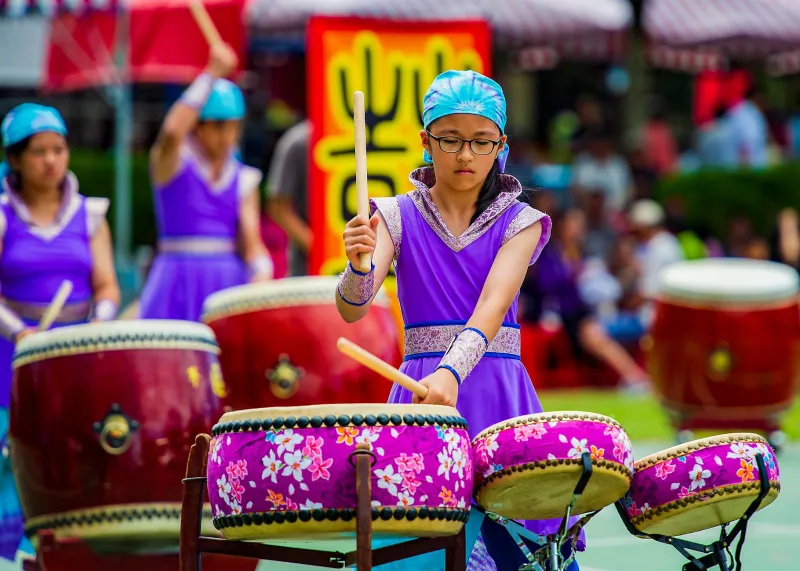
Taiko has always been, at its core, a communal art. The ensemble structure demands it. Players must listen to one another with acute attention, calibrate their strikes to a shared pulse, and surrender individual impulse to collective rhythm. In this sense, the drum has long been a natural gathering point for people seeking connection and shared purpose.
For LGBTQ+ practitioners across the United States, that gathering quality has taken on particular resonance. Over the past two decades, a growing number of queer-identified drummers, ensembles, and community organizers have found in taiko not only a performance tradition worth honoring but a framework for building the kind of chosen family that many queer people spend their lives constructing.
Their presence within American taiko is neither marginal nor monolithic. It is, rather, a varied and evolving conversation about who the tradition belongs to, what it can hold, and how an art form shaped by specific cultural and historical forces can be inhabited authentically by people whose identities were not imagined in its original context.
A Tradition With Complicated Hierarchies
To understand what LGBTQ+ taiko artists are navigating, it helps to understand something of what they entered. Traditional taiko practice—particularly in its Japanese context—has historically been organized around hierarchies of seniority, gender-coded performance expectations, and a physical aesthetic that emphasized a particular kind of strength and presence. Senior students deferred to masters. Certain drum sizes and performance postures were associated with male practitioners. The visual and sonic language of taiko was, in many of its conventions, built around assumptions that not everyone shares.
American taiko has always adapted these conventions rather than simply importing them wholesale. From its earliest days in the Japanese-American community, US-based practitioners have modified forms, invented new repertoire, and brought their own social contexts to bear on the tradition. The presence of women in prominent performance roles, for instance, became normalized in American taiko far earlier and more thoroughly than in many Japanese contexts.
Queer practitioners have, in many ways, continued this adaptive tradition. They have not uniformly rejected taiko's inherited structures; many describe a deep respect for the discipline, the seniority system, and the physical demands of serious practice. What they have sought, and in many cases built, is a version of that structure that does not require them to leave essential parts of themselves outside the dojo door.
Building Ensembles as Chosen Families
Several LGBTQ+-led or LGBTQ+-centered taiko ensembles have emerged in American cities over the past fifteen years. Their founding stories share certain recurring elements: a practitioner or small group of practitioners who loved taiko and felt, in mainstream ensembles, a persistent sense of partial belonging; a decision to create something new rather than wait for existing structures to change; and a community that coalesced around the new ensemble with a speed that surprised even its founders.
These groups vary considerably in their public identities. Some are explicitly and visibly queer in their branding, performance aesthetics, and community outreach. Others are less overtly identified, functioning as welcoming spaces without foregrounding queer identity as a defining feature. Both approaches reflect legitimate strategic choices about visibility, safety, and the kind of community the ensemble is trying to build.
What practitioners across these groups frequently describe is the experience of taiko practice as a site of physical and emotional integration. The drum demands full presence—there is no performing taiko from behind a mask of social performance. For people who have spent significant portions of their lives managing how they present to the world, this demand can be both challenging and profoundly liberating.
Challenging the Aesthetics of Power
Queer taiko artists have also brought distinctive perspectives to questions of performance aesthetics. Taiko's visual language—the wide stance, the raised arms, the expression of controlled force—has traditionally communicated a particular kind of power. That vocabulary is not neutral; it carries gendered and cultural associations that queer practitioners sometimes find worth examining and, in some cases, worth subverting.
Some ensembles have developed choreography and costuming that deliberately play with gender expression, blending elements of traditional taiko costuming with contemporary queer aesthetics. Others have expanded the emotional register of performance to include vulnerability, tenderness, and humor alongside the strength and precision that taiko is known for. These are not rejections of the tradition so much as expansions of it—arguments, made through movement and sound, that the drum can hold more than it has been asked to hold.
This aesthetic experimentation has not been universally embraced within American taiko communities. Some practitioners, including some who are themselves queer, express concern that departures from traditional form risk diluting an art whose power depends partly on its discipline and specificity. The conversation is ongoing and genuinely unresolved, which is perhaps a sign of its seriousness.
Navigating Two Cultural Contexts
For queer taiko artists who are also Japanese or Japanese-American, the work involves negotiating multiple sets of expectations simultaneously. Japanese cultural attitudes toward LGBTQ+ identity have shifted meaningfully in recent years, but the traditional contexts from which taiko draws remain, in many respects, conservative on questions of gender and sexuality. Practitioners who move between American taiko communities and Japanese cultural institutions—performing at Japan-sponsored events, training with visiting Japanese masters, or traveling to Japan to study—often describe the need to code-switch in ways that can be exhausting.
For non-Japanese LGBTQ+ practitioners, a different complexity applies. Playing an instrument and inhabiting a tradition that is not one's own cultural inheritance requires ongoing attention to the question of respect—what it means to practice taiko with integrity when one's relationship to its origins is that of an appreciative outsider. Queer identity adds another layer to this already nuanced negotiation.
Many practitioners describe community as the answer to both forms of complexity. When the ensemble itself is a space of genuine acceptance—when one's fellow drummers know and affirm the whole person, not merely the performer—the external negotiations become more manageable.
Visibility as Practice
For LGBTQ+ taiko ensembles that perform publicly, visibility is itself a form of cultural work. Appearing at Pride festivals, AAPI heritage events, community concerts, and taiko gatherings, these groups make an argument through presence: that taiko belongs to anyone willing to learn it with seriousness and care, and that queer people are among those who have done so.
The response from audiences is frequently described by performers as moving. Young LGBTQ+ people of Asian descent, in particular, often approach these ensembles after performances with expressions of recognition that the performers find meaningful. The drum, in these moments, is doing something beyond music. It is demonstrating a possibility—that one can be fully who one is and still belong to something ancient, demanding, and beautiful.
That possibility, practitioners say, is worth every hour of practice it took to earn it.